Sashank Krishnamurthy
Assistant Professor, IIT Madras
Research
My research focuses on integrated transceiver architectures for next-generation communication systems, with specific emphasis on interference-resilient wireless receivers based on N-path filtering and high-speed wireline and optical links for advanced computing platforms.
Wireless Integrated Circuits
Interference-Resilient Receivers Using N-Path Techniques
Low-Power IoT / BLE Receivers
This work focuses on ultra-low-power receiver architectures for BLE and IoT applications operating in dense ISM bands. These designs use N-path filtering and translational feedback concepts to achieve strong interference resilience at very low power levels.
- 580µW 2.2–2.4 GHz Receiver With +3.3 dBm Out-of-Band IIP3 for IoT Applications , S. Krishnamurthy, F. Maksimovic, A.M. Niknejad, IEEE European Solid-State Circuits Conference (ESSCIRC), 2018.
- Analysis and Design of Submilliwatt Interference-Tolerant Receivers Leveraging N-Path Filter-Based Translational Positive Feedback , S. Krishnamurthy, F. Maksimovic, L. Iotti, A.M. Niknejad, IEEE Transactions on Microwave Theory and Techniques (TMTT), 2021.
Higher-Order N-Path Filters
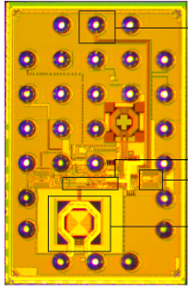
N-path filters translate low-pass baseband impedances to RF, enabling tunable bandpass filtering simply by adjusting the LO frequency applied to the switch network. This work focuses on extending “vanilla” N-path filters to achieve sharper selectivity and stronger rejection of interferers.
We pursue two broad approaches. The first uses higher-order baseband driving-point impedances to synthesize higher-order bandpass responses; as part of this work, we demonstrated the first-ever realization of a third-order all-pole driving-point impedance in an N-path filter system. The second approach constructs higher-order N-path filters by subtracting the responses of staggered low-order NPFs, developed in collaboration with Ashoke Ravi (Intel), Ofir Degani (Intel), Soumya Gupta (OSU), and Arun Natarajan (Yale).
Most of the work so far has focused on sub-6 GHz 5G and next-generation Wi-Fi bands. Extending these techniques to 6G / FR3 (7–24 GHz) operation is a promising avenue for future research.
- Enhanced Passive Mixer-First Receiver Driving an Impedance With 40 dB/decade Roll-Off, Achieving +12 dBm Blocker-P1dB, +33 dBm IIP3 and sub-2 dB NF Degradation for a 0 dBm Blocker , S. Krishnamurthy, A.M. Niknejad, IEEE Radio Frequency Integrated Circuits (RFIC) Symposium, 2019.
- Design and Analysis of Enhanced Mixer-First Receivers Achieving 40-dB/decade RF Selectivity , S. Krishnamurthy, A.M. Niknejad, IEEE Journal of Solid-State Circuits (JSSC), 2020.
- Synthesis and Design of Enhanced N-Path Filters With 60-dB/decade RF Selectivity , S. Krishnamurthy, A.M. Niknejad, IEEE Solid-State Circuits Letters (SSCL), 2020.
- An Enhanced Mixer-First Receiver With Distortion Cancellation, Achieving 80-dB/decade RF Selectivity and +8-dBm B1dB for Adjacent Channel Blockers , S. Krishnamurthy, A.M. Niknejad, IEEE Solid-State Circuits Letters (SSCL), 2021.
- A Channel-Selective, Bandwidth-Reconfigurable Wideband Low Noise Amplifier with Dual-Frequency N-Path Filters , S. Gupta, S. Krishnamurthy, A. Ravi, O. Degani, A. Natarajan, IEEE Radio & Wireless Week (RWW), 2026.
N-Path Filtering at mm-Wave Frequencies
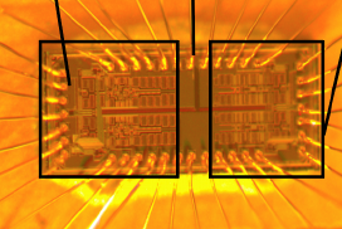
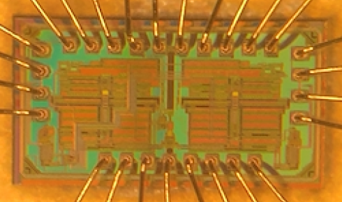
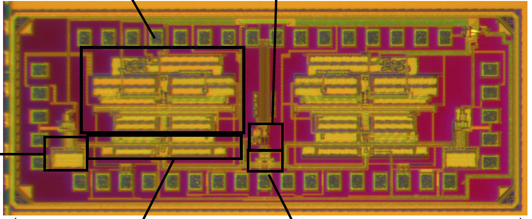
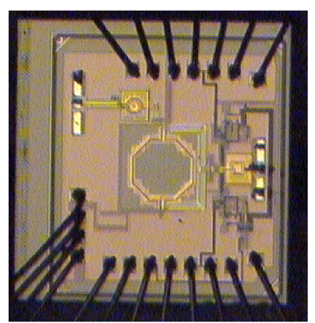
This work explores the extension of N-path filters to mm-wave receiver front-ends, enabling frequency-selective behavior at much higher operating frequencies than traditionally associated with switched-capacitor or mixer-first architectures. A central challenge is the generation of narrow LO pulses required to drive the N-path switches and the development of circuit techniques to address this without compromising the noise figure or the linearity advantages observed at lower frequencies.
Our work demonstrated a 28 nm CMOS prototype operating at 35 GHz, showing an order-of-magnitude improvement in in-band linearity compared to state-of-the-art solutions, while maintaining a modest noise figure. These results indicate that N-path filtering remains a strong candidate for mm-wave digital massive-MIMO array front-ends.
- 10–35 GHz Passive Mixer-First Receiver Achieving +14 dBm In-Band IIP3 for Digital Beam-Forming Arrays , S. Krishnamurthy, A.M. Niknejad, IEEE Radio Frequency Integrated Circuits (RFIC) Symposium, 2020.
- Design of High-Linearity Mixer-First Receivers for mm-Wave Digital MIMO Arrays , IEEE Journal of Solid State Circuits, JSSC 56(11), 2021, S. Krishnamurthy, L. Iotti, A.M. Niknejad.
High-Speed Optical and Wireline Links
This thrust focuses on CMOS transceivers for short-reach, high-bandwidth electrical and long-reach optical interconnects used in next-generation computing systems. The work targets low energy per bit, high bandwidth density, and co-packaged integration with high-performance integrated circuits.
High-Speed Co-Packaged VCSEL-Based Optical Links
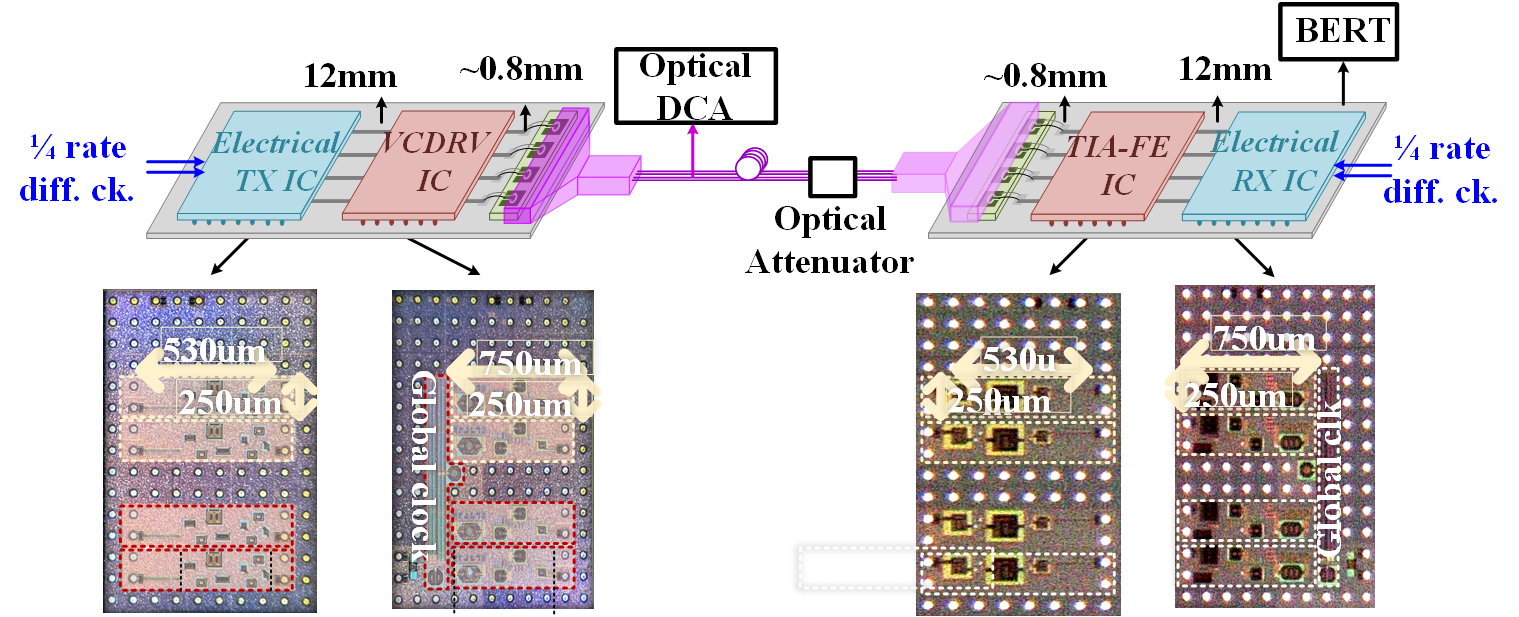
Co-packaged optics integrates the optical engine with the switch ASIC, eliminating bandwidth and reach limitations of pluggable modules and electrical interconnects while enabling energy-efficient datacenter connectivity using low-cost multimode VCSELs. In joint work with Susnata Mondal, Junyi Qiu, and Mozhgan Mansuri, our work demonstrates two energy-efficient CPO transceivers: a 2.9 pJ/b 50 Gb/s NRZ link and a 0.9 pJ/b 108 Gb/s PAM-4 optical engine. These results are enabled through transmitter/VCSEL driver design, low-power clocking architectures, matching networks that mitigate co-packaging parasitics, and receiver circuits leveraging high-linearity TIA front-ends, low-power equalization, and high-speed low-noise latch architectures.
- A 4× 64 Gb/s NRZ 1.3 pJ/b Co-Packaged and Fiber-Terminated 4-Channel VCSEL-Based Optical Transmitter , S. Mondal, J. Qiu, S. Krishnamurthy, J. Kennedy, S. Bose, T. Acikalin, S. Yamada, J. Jaussi, M. Mansuri, IEEE International Solid-State Circuits Conference (ISSCC), 2024.
- A 4Ch 64Gbps/Ch NRZ VCSEL-Based Co-Packaged and Fiber-Terminated Optical TX and 80Gbps Optical Driver , IEEE Journal of Solid State Circuits – Early Access, S. Mondal, J. Qiu, S. Krishnamurthy, J. Kennedy, S. Bose, T. Acikalin, S. Yamada, J. Jaussi, M. Mansuri.
- A 4× 50 Gb/s NRZ 1.5 pJ/b Co-Packaged and Fiber-Terminated 4-Channel Optical RX , S. Krishnamurthy, S. Mondal, J. Qiu, J. Kennedy, S. Bose, T. Acikalin, S. Yamada, J. Jaussi, M. Mansuri, IEEE VLSI Symposium on Technology and Circuits, 2024.
- A 4× 50Gb/s 2.9pJ/b NRZ VCSEL-Based Co-Packaged Optical Link With Fiber-Termination , IEEE Journal of Solid State Circuits – Early Access, S. Krishnamurthy, S. Mondal, J. Qiu, J. Kennedy, S. Bose, T. Acikalin, S. Yamada, J. Jaussi, M. Mansuri.
- A 0.9 pJ/b 108 Gb/s PAM4 VCSEL-Based Direct-Drive Optical Engine , S. Krishnamurthy*, S. Mondal*, J. Qiu, T. Acikalin, S. Bose, S. Yamada, J. Jaussi, M. Mansuri, IEEE International Solid-State Circuits Conference (ISSCC), 2025.
- A 108 Gb/s PAM-4 VCSEL-Based Direct-Drive Optical Engine for Co-Packaged Optics Applications , S. Mondal*, S. Krishnamurthy*, J. Qiu, T. Acikalin, S. Bose, S. Yamada, J. Jaussi, M. Mansuri, IEEE Journal of Solid-State Circuits (JSSC), 2025 — Early Access.

Next-Generation Die-to-Die Wireline Links
- A 48 Gb/s/lane 1.24 Tb/s/mm UCIe-Compliant Die-to-Die Link Over 30 mm Standard Package , S. Mondal*, S. Krishnamurthy*, S. Yamada, Z. Liu, J. Qiu, S. Bose, Z. Wu, G. Pasdast, J. Jaussi, M. Mansuri, IEEE International Solid State Circuits Conference (ISSCC), 2026 — Accepted.